I’ll be honest with you: we’re living through one of the most chaotic periods in retail history.
Think about how your customers actually shop today. They discover a product on Instagram, compare prices on your mobile app against Amazon. Next, they’re asking Alexa about its availability while also checking stock at an in-store kiosk before finally completing the purchase through WhatsApp because it’s convenient.
That’s not a futuristic scenario; it’s today! Every single one of those touchpoints expects perfect, consistent product information.
Here’s the thing: legacy monolithic platforms weren’t designed for this reality. They’re built on the assumption that you have one storefront, one database, one way of doing things. But when a customer sees different product descriptions on your app versus your website, or worse, encounters outdated pricing on one channel while another shows the current rate, trust evaporates instantly.
This is why enterprises are migrating to headless e-commerce. The promise is compelling: decouple your front-end presentation layer from your back-end commerce engine, giving you the freedom to build unique experiences for every channel without rebuilding your entire infrastructure.
However, headless architecture creates a data orchestration problem that most people don’t see coming. When you multiply your customer touchpoints, you exponentially multiply your potential for chaos. Product data is scattered across systems. Inconsistent attributes, conflicting information, and different teams updating different databases with no single source of truth.
That’s where Product Information Management (PIM) becomes non-negotiable. While everyone focuses on the shiny frontend possibilities of headless architecture, I’ve learned that the real strategic leverage sits in how you govern your product data. A PIM doesn’t just store information; it becomes an authoritative brain ensuring every customer interaction, regardless of channel, draws from the same trusted foundation.
Without PIM, headless commerce is just expensive chaos in a prettier package.
What is Headless PIM?
Think about the old desktop computers where the monitor was permanently wired to the tower. Want a better display? Too bad; you’re limited by what the manufacturer allows. That’s essentially how traditional e-commerce platforms work.
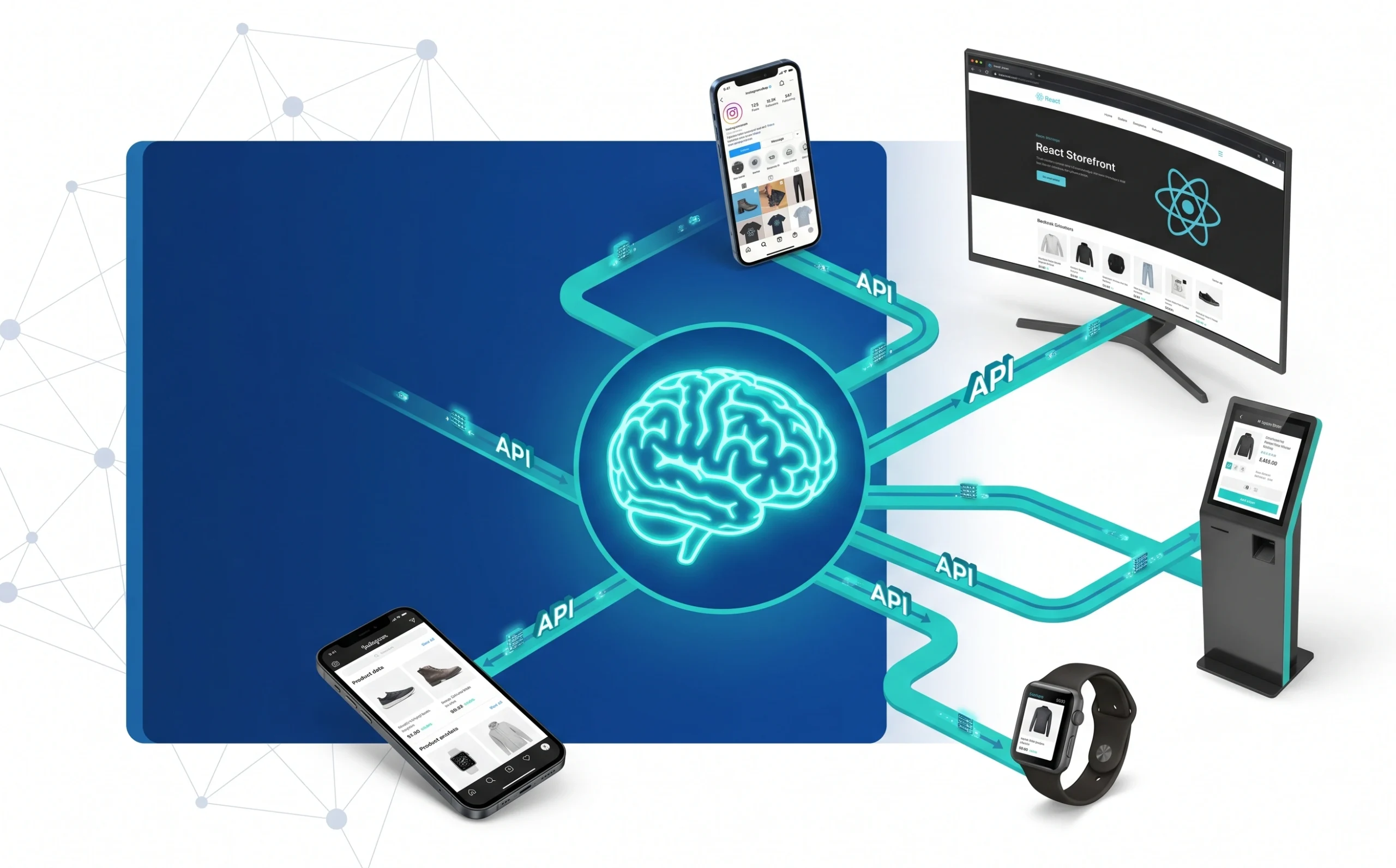
Headless architecture flips this model. It separates the presentation layer (what customers see) from the backend logic (where data lives and transactions are processed). Your backend exposes APIs and data pipelines that any frontend can tap into. Your mobile app, progressive web app, smartwatch interface, or even IoT devices request product data through these APIs and render it in a way that makes sense for that specific medium.
But here’s what the architectural diagrams don’t show you: those APIs need to pull from somewhere trustworthy.
A PIM in a headless e-commerce architecture acts as the single source of truth for all product information. Instead of data fragmented across your e-commerce platform, ERP, marketing systems, and those inevitable spreadsheets (we’ve all been there), a PIM system e-commerce centralizes everything. Product descriptions, technical specifications, images, videos, pricing attributes, categorization, and SEO metadata are all governed in one authoritative location.
When we implement this correctly at Digital Natives, your PIM feeds clean, structured data through APIs to every touchpoint. Your developers build a React-based storefront? It pulls from the PIM. Marketing launches a campaign microsite? Same source. Your mobile team wants to experiment with augmented reality product visualization? The 3D models come from the PIM.
The “headless” part applies to the PIM itself, too. Modern PIM systems are API-first by design, meaning they integrate with any technology stack without forcing you into a specific front-end framework. This architectural flexibility is precisely why CTOs prioritize PIM investments when planning headless migrations.
The Strategic Value: Speed, Autonomy, and Consistency
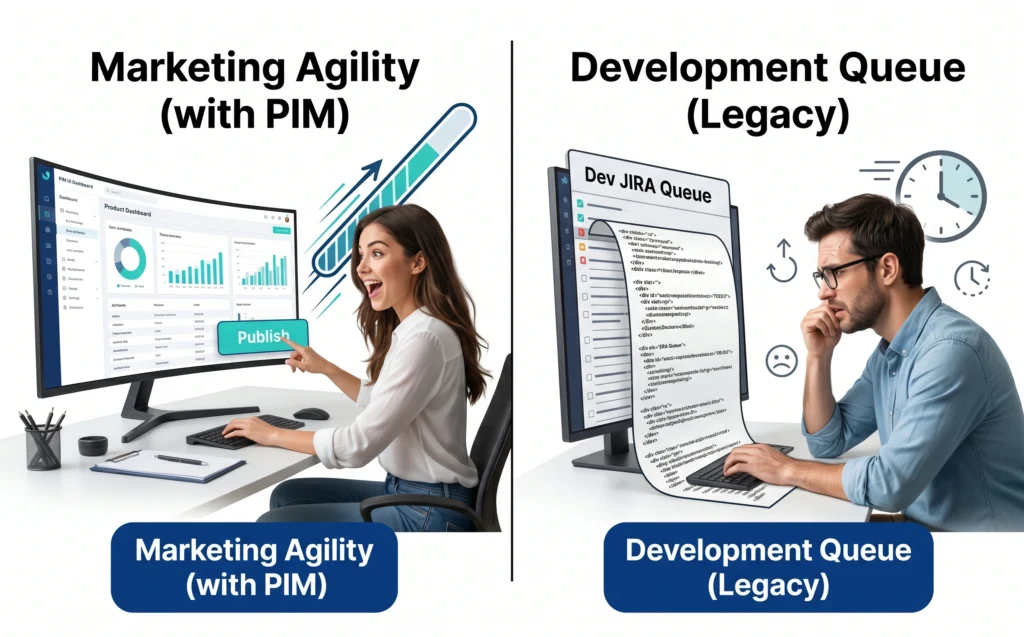
Let me paint a scenario we’ve seen play out countless times: Your marketing team wants to launch a flash sale featuring 200 products with updated copy emphasizing new sustainability credentials. In a traditional setup, this request enters the development queue. Wait time? Two weeks minimum. By the time it goes live, the moment has passed, and your competitor has already captured the trend.
With a PIM system properly integrated, marketing logs in, updates the relevant product attributes, and publishes. Changes propagate through APIs to every channel instantly. No developer involvement. No deployment cycle. Just speed.
This isn’t just operational convenience; it’s a competitive weapon. When you can react to market conditions, competitor moves, or trending topics within hours instead of weeks, you’re operating with an agility that translates directly to revenue.
Additionally, the autonomy works both ways. Your technical teams can iterate on front-end experiences without worrying about disrupting product data. Want to A/B test a completely different mobile interface? Go ahead. The PIM ensures data consistency regardless of how you choose to display it.
Now consider the omnichannel consistency angle. Your product description for a specific SKU should read identically whether a customer encounters it on your website, your Amazon listing, your mobile app, or a digital kiosk. Manual synchronization inevitably fails. Different content management systems create drift over time. A PIM enforces consistency programmatically.
This matters enormously for brand perception. Customers don’t mentally distinguish between your channels; they experience your brand holistically. Contradictory product information erodes trust faster than almost anything else.
The strategic value extends to your broader e-commerce strategy. With governance centralized in a PIM, you can enforce data quality standards. Mandatory fields ensure nothing is published without essential attributes. Workflow approvals mean legal can review claims before they go live. Version control lets you roll back if something breaks.
These might sound like operational details, but they’re strategic safeguards. In regulated industries or when expanding internationally, this governance infrastructure becomes non-negotiable.
Managing Complex Data for Global Markets
Headless commerce isn’t exclusively for B2C retailers selling sneakers and apparel. Some of the most compelling use cases we’ve built emerge in B2B scenarios where product data gets genuinely complex.
Consider a manufacturer selling industrial equipment globally. A single product might carry dozens of technical specifications, compliance certifications varying by region, pricing tiers based on volume commitments, different packaging configurations for different markets, and multi-currency support with regional tax implications.
Managing this in a monolithic platform or spreadsheets creates exponential complexity as you scale. A PIM gives you the data modeling flexibility to handle it elegantly.
Take pricing structures as an example. For global B2B merchants, a PIM doesn’t just store a price tag; it manages complex pricing attributes. It allows you to define granular data, like FOB or determining factors that help international buyers understand total landed costs. When expanding globally, your data needs to be precise. A robust PIM allows you to store specific pricing logic, such as determining if a quote includes insurance and freight. Understanding the CIF price meaning (Cost, Insurance, and Freight) is crucial for B2B buyers, and your PIM should dynamically serve these specific pricing attributes to international customers based on their location and business context.
This level of precision matters when you’re quoting projects worth hundreds of thousands of dollars. Your customer from Saudi Arabia needs to see the CIF price to Jeddah port automatically calculated. Your European distributor needs Ex Works pricing from your Czech warehouse. A sophisticated PIM models these variations as product attributes, then exposes the relevant pricing through APIs based on customer context.
The same principle applies to technical specifications. An automotive parts supplier might need to manage compatibility matrices, which parts fit which vehicle models across which years. That’s relational data requiring a searchable, filterable presentation across multiple interfaces.
Without a PIM, you’re building custom database schemas and writing bespoke code for every channel. With a PIM, you model it once and distribute it everywhere. The ROI calculation practically writes itself.
Future-Proofing with Headless Architecture
Let’s look at the data beyond regional specifics. The global momentum behind headless commerce is undeniable.
The headless commerce market will grow from $1.74 billion in 2025 to $7.16 billion by 2032 at a 22.4% CAGR, according to Coherent Market Insights. This growth rate outpaces overall e-commerce growth, signaling sustained enterprise investment in decoupled architecture.
More importantly, businesses report 42% average conversion rate increase after headless implementation, with companies seeing an average 24% increase in revenue, according to Swell. That’s not incremental improvement, it’s transformational impact.
But here’s the cautionary tale buried in those numbers: not every headless implementation succeeds. The ones that struggle typically have one thing in common: they fixed the presentation layer but ignored the data layer.
You can build the most beautiful React storefront, the most intuitive mobile app, the most innovative voice commerce integration, and still fail if your product data is inconsistent, incomplete, or scattered across systems.
This is why forward-thinking CTOs bundle PIM investments with their headless migrations. They’re not separate initiatives; they’re two sides of the same architectural evolution.
The future-proofing element is real. Consider channels that don’t exist yet or are just emerging:
- Augmented reality shopping experiences require 3D product models
- AI-powered shopping assistants need structured product attributes to make recommendations
- Blockchain-based authenticity verification requires immutable product provenance data
- Metaverse storefronts might need entirely different product presentation paradigms
A well-implemented PIM with robust APIs can feed all of these because it’s channel-agnostic by design. You’re not rebuilding your data infrastructure every time a new channel emerges; you’re simply connecting a new frontend to existing data pipelines.
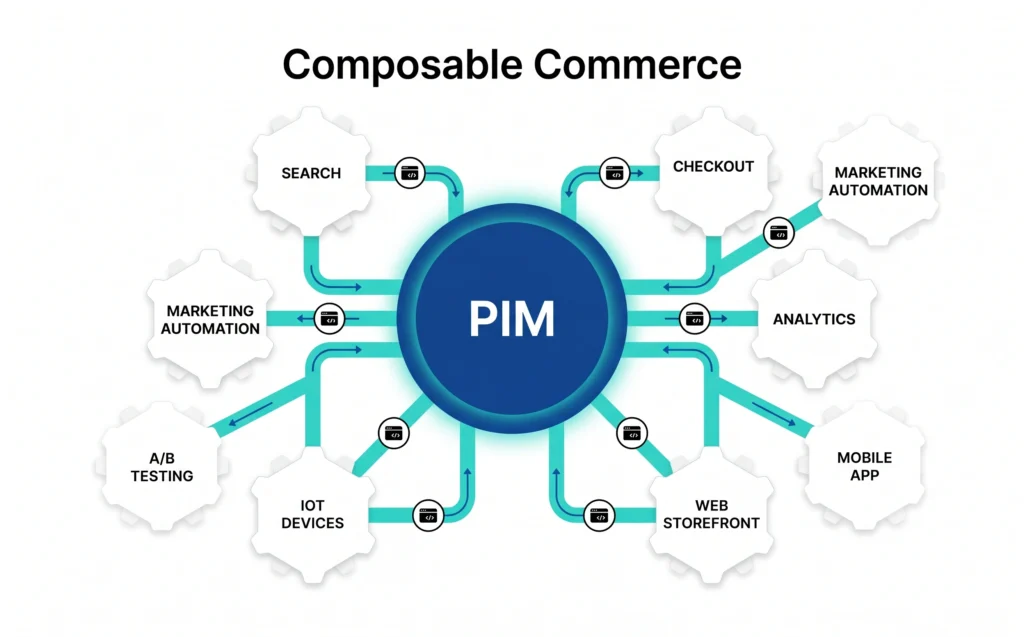
The headless e-commerce architecture pattern also aligns with broader technology trends toward composable commerce. Rather than buying a monolithic platform that does everything (and nothing particularly well), you’re assembling best-of-breed components: a specialized PIM for product data, a dedicated search engine for discovery, a purpose-built checkout solution for conversions.
This composability creates flexibility, but it also creates integration challenges. Your commerce stack might involve a dozen different services that need to communicate. PIM often sits at the center of this constellation, feeding product context to search, checkout, analytics, marketing automation, and more.
Building for Scale, Not Just for Now
The enterprises succeeding with headless architecture share a common perspective: they’re building for the commerce environment five years from now, not just solving today’s problems.
That means anticipating data complexity as you grow. More SKUs, more markets, more channels, more regulatory requirements, more customization. The data architecture you choose today either scales with that complexity or becomes the bottleneck, forcing a painful re-platforming later.
PIM isn’t sexy technology. It doesn’t have the visual appeal of a beautiful storefront redesign. But it’s the infrastructure that makes that redesign possible without data migration nightmares. It’s what lets you launch in a new market without building custom data pipelines. It’s what ensures your brand consistency holds as you expand from 2 channels to 20.
The strategic role of PIM in headless architecture is ultimately about risk mitigation. You’re de-risking future channel expansion, de-risking data quality issues, de-risking vendor lock-in, and de-risking the organizational bottlenecks that come from centralizing too much technical dependency.
When your marketing team can manage product content, your pricing team can update complex attributes, and your technical team can launch new experiences, all without stepping on each other, you’ve built an organization as scalable as your technology.
Why This Matters Now
Headless architecture represents more than a technology upgrade. It’s a philosophical shift toward flexibility, speed, and customer-centricity in how you approach commerce.
But philosophy needs plumbing. The data foundation you build determines whether your headless investment delivers on its promise or becomes another expensive disappointment.
A properly implemented PIM transforms product data from a liability into an asset. It changes product launches from months-long projects into same-day deployments. It shifts data quality from a periodic cleanup exercise to an enforced standard. And it positions your commerce infrastructure to adapt rather than rebuild as markets evolve.
For enterprises evaluating their next architectural move, the question isn’t whether to implement headless e-commerce; the question is whether you have the data infrastructure to make it work.
At Digital Natives, we’ve learned that the most successful digital transformations don’t just modernize the front-end; they rebuild the foundation. PIM isn’t just software; it’s a strategic asset that determines whether your commerce architecture can scale with your ambition.
Ready to audit your current architecture and build a future-ready stack? We specialize in implementing headless solutions with the PIM foundation that enterprises actually need to succeed. Let’s talk about bringing your ideas to reality. Connect with us to design your roadmap.