Let me be direct with you: the brands that will dominate their categories in 2026 are not necessarily the ones with the deepest ad budgets. They’re the ones that built smarter infrastructure while everyone else was still arguing about which social platform to post on.
Marketing has always rewarded the bold, but 2026 represents something different. The rules aren’t just shifting; they’re being rewritten at the architectural level. AI is no longer a department or a tool you bolt onto the side of your strategy. First-party data is no longer a “future consideration.” And trust, real, earned, technically demonstrable trust, is now a hard ranking and revenue factor, not a soft brand value. The digital marketing trends reshaping this landscape are not incremental updates to existing playbooks. They are structural breaks from the past.
I’ve spent years at Digital Natives helping CMOs, Marketing Directors, and Founders navigate exactly these kinds of inflection points. And I can tell you with confidence: the brands that survive the next wave of the internet are the ones that have stopped treating technology as a shortcut and started treating it as a foundation.
Basic automation, the stuff that felt cutting-edge three years ago, is now the floor, not the ceiling. Scheduling tools, basic email sequences, and generic retargeting. That’s table stakes. What separates a brand with compounding growth from one that’s treading water is whether its entire digital ecosystem is designed to learn, adapt, and personalise at scale.
That’s what this guide is about. Not hype. Not a list of buzzwords to drop in your next board presentation. A clear-eyed look at the digital marketing trends that are actively reshaping how smart brands acquire, convert, retain customers, and what you need to do about them right now.
Top 5 Digital Trends Marketers Must Watch in 2026
Trend 1: AI Becomes the Core Infrastructure; Not Just a Tool
There was a moment, maybe two years ago, when using AI to write a product description felt innovative. That moment has passed.
In 2026, AI isn’t a feature you add to your marketing stack. It’s the connective tissue running through every layer of it: content creation, audience segmentation, campaign optimisation, predictive analytics, and customer journey mapping. The question is no longer “should we use AI?” It’s “how deeply is AI embedded in our infrastructure, and are we getting the compound returns that should come with that depth?”
The numbers reflect this shift. According to Digihify’s analysis of content marketing trends, 94% of marketers plan to use AI for content creation in 2026. Let that land for a second. Nearly the entire industry. Which means the competitive edge is no longer in using AI; it’s in using it better, more intentionally, and with more proprietary data feeding it than your competitors have.
The brands winning at this level are the ones training models on their own customer data, their own conversion history, and their own content performance. They’re not using AI as a commodity. They’re using it as institutional knowledge at scale. And that requires a level of technical infrastructure that most brands haven’t built yet — which is exactly where the opportunity lies.
Trend 2: Hyper-Personalisation as the Ultimate Conversion Lever
Generic marketing is dead. Not dying. Dead.
I’ve seen brands spend enormous budgets on broad-audience campaigns built around the assumption that volume compensates for irrelevance. It doesn’t. Not anymore. Today’s consumer — B2C or B2B — has been trained by years of algorithmic content to expect relevance as a baseline. When your message doesn’t feel personal, it doesn’t just get ignored. It actively erodes trust.
Research cited by IE University’s Digital Marketing programme makes the business case plainly: 75% of consumers are now more likely to purchase from brands that deliver personalised content and experiences. Three in four. At that scale, personalisation isn’t a nice-to-have — it’s the difference between a brand that compounds and one that churns.
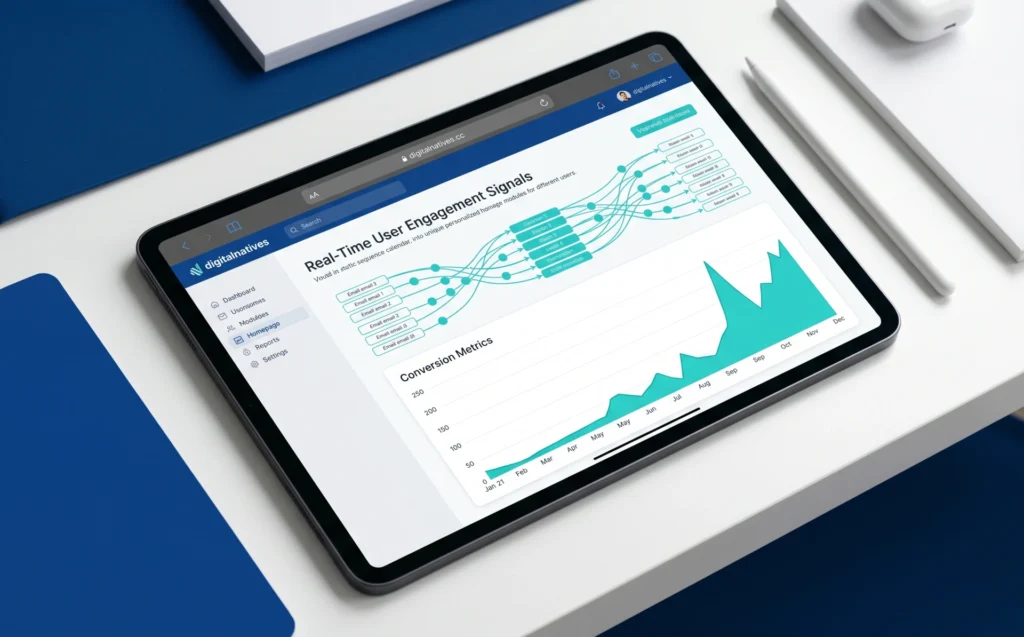
But here’s where most brands fall short: they confuse personalisation with name-merge tags and “based on your last purchase” emails. Real hyper-personalisation is behavioural and contextual. It means a user who has visited your pricing page three times in a week sees a different homepage experience than a first-time visitor. It means your email sequences adapt in real-time based on engagement signals, not a static drip schedule. At Digital Natives, we architect these systems at the platform level — because tacking personalisation onto an infrastructure that wasn’t designed for it is like fitting a racing engine into a car with standard brakes.
Trend 3: Programmatic Advertising Dominates the Revenue Landscape
If you’re still allocating media spend through manual negotiation and insertion orders, this section is especially for you.
Among the Top Digital Trends reshaping digital advertising, the rise of programmatic is perhaps the least controversial — because the numbers are simply too large to argue with. According to DemandSage’s digital marketing statistics, programmatic advertising is projected to account for 87% of all digital ad revenue by 2026. Eighty-seven percent. That’s not a dominant channel. That’s the channel.
What makes this particularly important for CMOs is the sophistication gap it creates. Programmatic done well — with clean audience data, rigorous exclusion lists, genuine creative testing, and proper attribution — is genuinely powerful. Programmatic done poorly, by teams who are essentially automating guesswork, is a very fast way to burn budget with almost nothing to show for it.
The infrastructure underneath your programmatic strategy matters as much as the strategy itself. Your audience segments need to be fed by real first-party data (more on that shortly). Your creative assets need to be built for variation and testing, not for a single static placement. And your attribution models need to be sophisticated enough to tell you what’s actually working — not just what got the last click.
Trend 4: The E-E-A-T Era of Search and Zero-Click Ecosystems
This is the trend I see most brands underestimating, and it’s the one that will cause the most damage to those who continue to ignore it.
Google’s AI Overviews — the generative search summaries that now appear above organic results for a growing range of queries — have fundamentally altered the economics of search traffic. For categories where AI Overviews are prevalent, zero-click searches (where the user gets their answer from the SERP and never visits a website) are compressing organic traffic across the board. The brands that survive this shift are the ones that become the source Google’s AI cites — not the ones hoping to rank tenth for a keyword.
That requires a genuine commitment to E-E-A-T: Experience, Expertise, Authoritativeness, and Trustworthiness. This is not an SEO checklist item. It is a fundamental philosophy about how you publish and how you build your digital presence. Among the future digital marketing trends that will define the next three to five years, the shift toward trust as a measurable ranking and revenue signal is arguably the most consequential.
In our experience building digital platforms at Digital Natives, the brands that perform best in this environment have three things in common: they publish original perspectives backed by real data; they demonstrate author credentials clearly and consistently; and they invest in structured data (Schema markup) to communicate that expertise to search engines in a machine-readable format. Trust is no longer a soft brand value. It’s technical, it’s measurable, and it’s a hard commercial lever.
Trend 5: First-Party Data and the Privacy-First Web
The third-party cookie is gone. And a surprising number of brands still haven’t fully reckoned with what that means for their advertising and analytics infrastructure.
Here’s the reality: the ad targeting that many brands built their acquisition models on — the granular behavioural tracking across third-party domains, the retargeting pools built on cross-site data — is being systematically dismantled by browser policy, regulation, and user preference. The brands that haven’t started building their own data ecosystems are not just behind. They’re running toward a cliff.
First-party data — information you collect directly from your audience through owned touchpoints — is the only durable alternative. Loyalty programmes that give users a genuine reason to identify themselves. Gated content that exchanges real value for real contact details. Email and SMS lists built on explicit opt-in, not inferred consent. Interactive tools, quizzes, and assessments that generate zero-party data (information a user voluntarily shares about their preferences and intent).
I’ve seen brands build remarkably sophisticated first-party data assets in twelve to eighteen months when they approach it with intention. And the downstream effects extend beyond advertising — cleaner data means better personalisation, better AI training, and better product decisions. It’s not just a compliance strategy. It’s a genuine competitive moat.
Real-World Business Use Cases
Theory lands differently when you can see it working. Here are two scenarios that illustrate how these trends translate to real commercial outcomes.
Case 1: The SaaS Brand That Turned Personalisation Into Pipeline
A mid-sized global SaaS company — operating in the project management space — came to us with a conversion problem. Traffic was healthy. Demo booking rates were not. Their website treated a Series B-funded enterprise prospect the same way it treated a freelancer on a free trial, and their email sequences ran on a calendar, not on behaviour.
We rebuilt their digital journey around the digital marketing trends of AI-driven personalisation and first-party data. Website content modules adapted dynamically based on firmographic data and session behaviour. Email sequences triggered on intent signals — a third visit to the security compliance page meant an enterprise-track sequence, not a generic nurture. AI-assisted lead scoring prioritised outreach based on engagement depth, not recency alone.
Demo bookings increased by 38% within the first quarter. Not from more traffic. From a smarter conversation with the traffic they already had.
Case 2: The E-Commerce Brand That Survived the SEO Disruption
A regional e-commerce brand selling premium outdoor equipment had watched its organic traffic decline steadily as AI Overviews began absorbing informational search queries in its category. Their content had been built entirely around keyword targeting, with no genuine authorial voice, no original data, and no structured data implementation. When the SERP changed, they had nothing to defend.
We rebuilt their content strategy from the ground up with E-E-A-T as the design principle. Expert-authored buying guides with clear author credentials. Original product testing data, including performance benchmarks that their competitors weren’t publishing. Schema markup across every product and article page. And a structured internal linking architecture that concentrated authority around their highest-value category pages.
Within six months, three of their pillar content pieces were being cited directly in AI Overviews. Organic traffic recovered and, in two target categories, exceeded previous peaks — because the strategy was now built on trust and authority, not keyword density.
On-Page Optimisation Tips for 2026
Strategy without execution is just a presentation. Here are three things you can do right now to align your digital real estate with where the Top Digital Trends are heading.
- Implement Structured Data Across Every Meaningful Page. Schema markup is how you speak directly to search engines — and increasingly, to AI systems deciding which sources to surface in generative results. At a minimum, implement Article, Product, FAQPage, and Organization schemas. If you’re in e-commerce, Review and Offer schemas are non-negotiable.
- Optimise for Semantic Search, Not Just Keywords. Search engines have moved well beyond exact-match keyword matching. They understand intent, context, and conceptual relationships. Your content needs to comprehensively address a topic — answering the adjacent questions a user might have, not just the primary query. This is how you become a trusted source rather than a single-query result.
- Treat Core Web Vitals as a Revenue Metric, Not a Technical Task. LCP (Largest Contentful Paint), INP (Interaction to Next Paint), and CLS (Cumulative Layout Shift) are Google’s primary signals for page experience quality. Brands with strong Core Web Vital scores not only rank better — they convert better, because speed and stability reduce friction at every point in the user journey. This is as much a business conversation as it is a developer conversation.
The Signal Through the Noise
Every technology cycle produces noise — predictions that don’t pan out, platforms that peak early, tools that promise transformation and deliver marginal gains. What makes the digital marketing trends outlined in this guide different is that they’re not speculative. They’re structural. AI as infrastructure, first-party data, E-E-A-T, and hyper-personalisation aren’t features of some possible future. They’re the conditions of the present, becoming more pronounced with every quarter.
But here’s the thing I come back to at the end of every strategy conversation: technology changes. The need to build authentic, relevant, trustworthy connections with human beings does not. The best brands of 2026 will be the ones that use smarter infrastructure to deliver more genuinely human experiences, not the ones that automate everything and call it innovation.
The Top Digital Trends are the vehicle. The destination is still the same: a brand your audience trusts enough to choose, again and again.
Let’s Build Your Future-Proof Digital Strategy
If any of this has made you look at your current digital infrastructure differently, that’s the point. The gap between where most brands are and where they need to be isn’t insurmountable — but it requires a clear-eyed audit of what’s working, what’s fragile, and what needs to be rebuilt.
At Digital Natives, we help ambitious brands do exactly that. From AI-driven personalisation architecture to E-E-A-T content strategy to programmatic infrastructure and first-party data ecosystems — we build the digital foundations that compound over time, not just the campaigns that spike and fade.
Reach out to the Digital Natives team, and let’s audit your current digital strategy together. No generic frameworks. No templated outputs. A real conversation about where you are, where you need to be, and the most direct path between the two.
Digital Natives is a forward-thinking digital agency specialising in UI/UX design, modern web development, and crafting unique digital experiences. Visit us at digitalnatives.cc.